
For immediate release
Oct. 22, 2026
Download illustrations and video of the firefly’s flash pattern
In a flash, or more precisely several flashes in quick succession, the similar firefly (Pyractomena similis) was rediscovered and re-entered the scientific record during a survey of a meadow in Delaware in the United States. Prior to the successful survey, the similar firefly had not been documented since 1983. The rediscovery was included in a recent paper published in the Journal of Lost Species tallying the status of all species of fireflies in the United States and Canada. The similar firefly was one of the most wanted lost species by Re:wild’s Search for Lost Species, which is the largest global search for species that have not had a documented sighting for 10 years or more.
“I was confident I had found the species the moment I saw the flash pattern,” said Christopher Heckscher, an entomologist and ecologist at Delaware State University who made the rediscovery. “The amber color of the flash and the long rhythmic pattern did not match any other firefly I was familiar with in this region.”
The similar firefly historically ranged across parts of the eastern and southern United States. Before it was lost to science in 1983, scientists had not studied the species in depth.
“There’s hardly any information out there about it,” said Heckscher. “That’s true for a lot of our fireflies, even our common species. It blows your mind because you think of them as a charismatic insect, and you think every kid, if they wanted to be an entomologist, would be running around catching fireflies.”
One of the few things that scientists know about the firefly is that it lives in fields and meadows that are near water.
Heckscher surveyed three different sites for the similar firefly between May and June 2026 in the mid-Atlantic states of Delaware and Maryland. He visited Fair Hill Natural Resources Management in Maryland and White Clay Creek State Park in Delaware, but didn’t find any similar fireflies at those sites. On the last night of his surveys on June 3, he visited Brandywine Creek State Park in Delaware where he focused on searching a mature meadow with shrubs, brush and plenty of low vegetation.
“The habitat is not terribly common,” said Heckscher. “We think of fields and open meadows as being pretty common, but most times we’re managing them for other things, maybe livestock, or we’re mowing them once in a while. The fact that this was just allowed to grow naturally as a meadow, that’s probably what this firefly is keyed in on in terms of its habitat.”
Delaware’s Department of Natural Resources and Environmental Control (DNREC) carefully manages 34 nature preserves to protect their natural and cultural features, one of which is Brandywine Creek State Park. The park includes four nature preserves and its hilly topography is distinct within Delaware, which is primarily flat.
As night fell and fireflies started emerging and flashing their bioluminescent signals in the park’s meadow, Heckscher began recording the flash patterns. Male similar fireflies flash a unique string of short, amber-colored pulses of light to attract females. Males typically emit between 10 and 20 pulses in quick succession followed by a short break and then resume the pulses.
Heckscher was able to see between eight and about a dozen fireflies flashing the pattern that matches the similar firefly.
Heckscher also saw spring four-flashers (Photuris quadrifulgans), a species that also has a flicker-flash, in the meadow, and believes that it may be possible that other lost fireflies that prefer that type of meadow habitat could be living there as well.
“The discovery of this long-lost firefly is a testament not only to the division’s mission of protecting and preserving open space and critical habitat in Delaware, but also to the long history of state parks supporting and encouraging scientific research,” said Chris Bennett, environmental stewardship program manager at the DNREC Division of Parks and Recreation in Delaware.
In order to definitively confirm that the flash was being made by the similar firefly, Heckscher observed one of the fireflies under a microscope. With the help of the magnification, he was able to see genitalia characteristics that are only known to belong to the similar firefly.
Scientists have mounted searches for the similar firefly before in Georgia and North Carolina, but didn’t find it at the sites they surveyed. The firefly may have become lost to science due to a combination of habitat destruction, a short breeding season when the species is active, the nocturnal nature of the species, and a lack of dedicated searches for it.
Scientists will need to conduct follow-up surveys in similar types of habitats in Delaware and other areas to understand the current range of the similar firefly and its population size.
“Many people are unaware that the U.S. has so many different firefly species, let alone that many of these have been lost to science for a decade or more,” said Candace Fallon, senior conservation biologist and firefly lead at the Xerces Society, which coordinates the Firefly Atlas, and one of the authors of the paper published in The Journal of Lost Species. “The good news is that a lot of these species likely aren't gone forever—they are simply overlooked. And we've found that increased awareness, targeted searches by experts, dedicated funding, and data sharing by community scientists can lead to some pretty incredible rediscoveries.”
The recent paper on the status of fireflies in the U.S. and Canada highlighted that there are 69 firefly species with knowledge gaps about their conservation status and 48 species with no data at all.
“Despite being very charismatic, there is still a lot we don't understand about fireflies,” said Anna Walker, species survival specialist for invertebrates at New Mexico Biopark Society and co-author of the recent paper. “In fact, 28 species in the United States and Canada are considered lost, which is 16% of the known species. They are not usually lost because they have declined or are threatened, but simply because no one has looked for them. The rediscovery of Pyractomena similis is a good example of what we can expect for many of the lost firefly species, if we are willing to just go out and look. If we can devote a few resources to surveys for these species, or in some cases to taxonomic work to better understand relationships between species, we will likely be able to rediscover the vast majority of them. Community science is a powerful resource as well. There are numerous species that were considered lost because they had not been recorded in decades, but recently showed up on platforms like iNaturalist. We need all the help we can get to better understand our firefly fauna, and community scientists are an irreplaceable resource in the effort.”
Since 2017, working with local partners around the world, Re:wild’s Search for Lost Species has rediscovered 14 of its most wanted species: Jackson’s climbing salamander in Guatemala, Wallace’s giant bee in Indonesia, velvet pitcher plant in Indonesia, silver-backed chevrotain in Vietnam, Somali sengi in Djibouti, Voeltzkow’s chameleon in Madagascar, Sierra Leone crab in Sierra Leone, Pernambuco holly in Brazil, De Winton’s golden mole in South Africa, Attenborough’s long-beaked echidna in Indonesia, Fagilde’s trapdoor spider in Portugal, big puma fungus in Chile, Omiltemi cottontail rabbit in Mexico, and similar firefly in the United States.
Re:wild’s Search for Lost Species is supported by the Colossal Foundation.
Additional quotes
Benji Barca, exploration manager, Re:wild
“Bioluminescent species are fascinating and fireflies are some of the most recognizable insects in the world, which makes it surprising that they could be lost to science. It’s important to keep looking for them and learning about them, not just for the beauty that they create, but for the biodiversity they represent.”
Matt James, executive director, The Colossal Foundation
“Finding a lost species is one of conservation’s most hopeful moments, but rediscovery is only the beginning. The Colossal Foundation’s partnership with Re:wild is designed to turn that moment into lasting conservation action. Together, we support field teams searching for plants, animals and fungi that have gone undocumented for decades, then help move rediscovered species from discovery to recovery through genetic rescue, reintroduction and broader ecosystem restoration. Now, the work shifts to understanding the population of the firefly and protecting its habitat. This discovery is also a powerful reminder that every species matters, no matter how small, and that investing in field science and local conservation expertise can give us a second chance to help species before it’s too late.”
# # #
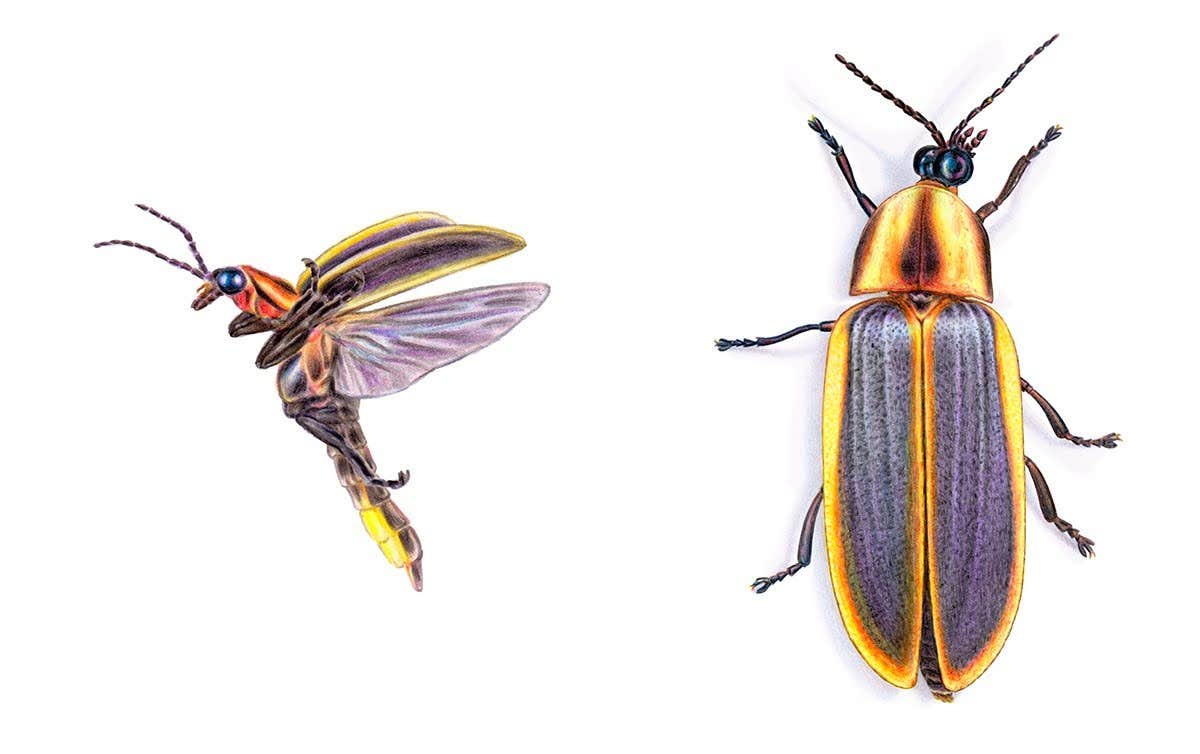
Photo: An illustration of the similar firefly (Pyractomena similis). The species looks very similar to other fireflies that share its range, but it has a distinct flash pattern, which helped Christopher Heckscher, an entomologist and ecologist, rediscover the species that had been lost to science since 1983. (Illustration by Mauricio Alvarez)
Re:wild
Re:wild protects and restores the wild. We have a singular and powerful focus: the wild as the most effective solution to the interconnected climate, biodiversity and human wellbeing crises. Founded by a group of renowned conservation scientists together with Leonardo DiCaprio, Re:wild is a force multiplier that brings together Indigenous peoples, local communities, influential leaders, nongovernmental organizations, governments, companies and the public to protect and rewild at the scale and speed we need. Learn more at rewild.org.
Xerces Society
The Xerces Society for Invertebrate Conservation is a donor-supported nonprofit organization that protects our world through the conservation of invertebrates and their habitats. Xerces works throughout North America to conserve pollinators and other invertebrates, protect endangered species, and reduce pesticide use and impacts. For over 50 years, we have been champions of Earth’s most biodiverse and overlooked animals, protecting the life that sustains us. Learn more at xerces.org.
Contact
Devin Murphy
dmurphy@rewild.org
+1 512-686-6188
Candace Fallon
candace.fallon@xerces.org
+1 503-212-0788

Devin Murphy
Associate Director of Communications
Devin Murphy is Re:wilds’s Associate Director of Communications and helps Re:wild and its partners tell stories about the work they do to protect wildlife and wildlands around the planet. Her favorite stories about conservation include fascinating and little-known species and the dedicated humans protecting them.