
A big-eyed, venomous primate that had not been documented in scientific literature since the 1930s has been hiding in plain sight on the Indonesian island of Bangka, turning up in backyards, along roadsides and on power lines, and prompting local residents finding them to call the Alobi Wildlife Rescue Center for help.
A new study published in the scientific journal Spixiana confirms that the Bangka slow loris, one of Re:wild’s most wanted lost primates, still survives across much of the island. The evidence comes from more than 90 Bangka slow lorises that Alobi rescued between 2015 and 2025. Alobi co-authored the published study with the Haus des Meeres Aqua Terra Zoo in Vienna and the Taman Safari Prigen Conservation Breeding Ark. The study’s publication coincides with the celebration of Lost Species Month in October.
The Bangka slow loris is classified as critically endangered (possibly extinct) by the IUCN Red List of Threatened Species. Although scientists had not documented the species in nearly a century, it was never lost to the people of Bangka. For more than a decade, Alobi has been rescuing slow lorises reported by residents and local authorities across the island, caring for the animals and returning those that recover to protected forest. Until now, those encounters had not yet made their way into the scientific literature.
The study began with a conversation in Java. While visiting the Taman Safari Prigen Conservation Breeding Ark, study co-author Timon Glaw of the Haus des Meeres Aqua Terra Zoo learned from conservationist Jochen Menner that the Bangka slow loris was listed as critically endangered (possibly extinct) by the IUCN Red List and was among Re:wild’s most wanted lost primates. Menner connected him with Alobi, where he learned that the rescue center had something the scientific record did not: documented encounters with the species. That discovery brought Alobi, Haus des Meeres Aqua Terra Zoo and the Taman Safari Prigen Conservation Breeding Ark together to analyze the records and publish the new study.
“We are glad to contribute to the scientific record to show that the Bangka slow loris is not lost, but the species is still very close to extinction,” said Langka Sani, director of the Alobi Wildlife Rescue Center. “Its natural habitat on Bangka Island has shrunk significantly because of illegal tin mining and massive land clearing for oil palm plantations. We ask people around the world to support us in saving the Bangka slow loris while we still can.”
According to the study, Alobi rescued Bangka slow lorises in all four regencies of Bangka Island and in the city of Pangkal Pinang, which suggests the species may still live across much of the island. Of the more than 90 slow lorises Alobi rescued, 86 recovered and were released at seven sites on Bangka. Alobi’s team chose the release sites carefully, focusing on the island’s larger forest fragments that can still provide good habitat and have some level of legal or practical protection.
“Bringing the Bangka slow loris back onto the scientific radar is only the first step,” Glaw said. “We now know the species has survived in several parts of Bangka, and we urgently need a long-term conservation strategy built on population surveys, genetic studies and, above all, protection of its remaining habitat. The next challenge is to make sure it does not actually become extinct.”
Bangka island is home to more than 1 million people. According to the study, human settlements, roads and power lines are significant threats to the species. Slow lorises are also a target for the pet trade across their range in Asia.
The study’s authors recommend a conservation program on Bangka that protects suitable habitat and continues monitored releases following IUCN Species Survival Commission guidelines. They also propose a conservation breeding program that could help conservationists learn more about the species’ biology and behavior. Next steps include population surveys, genetic studies and tracking how released slow lorises fare once they are back in the forest.
“The team at Alobi has spent more than a decade quietly rescuing, healing and releasing these animals, and their careful records are what have finally now brought this primate back into scientific view,” said Benji Barca, Re:wild’s exploration program manager. “It is another reminder that conservation depends on the knowledge of local communities, Indigenous Peoples and others who know these species and landscapes intimately. A species can disappear from the scientific record without disappearing from the lives of the people who share its home.”
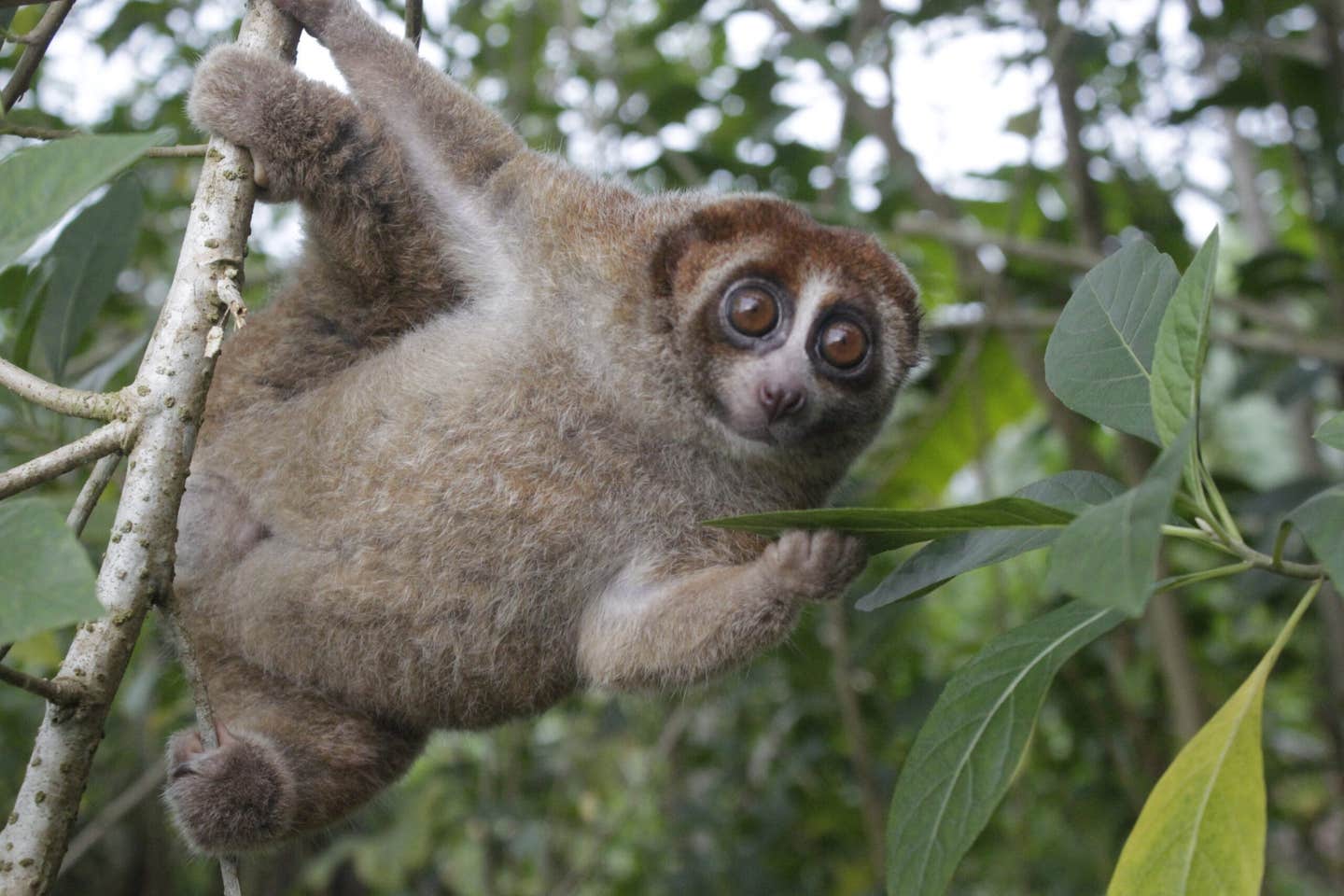
Slow lorises are among the world’s most unusual primates. They are the only primates known to be venomous: they lick a gland on the inside of their upper arm and mix its secretion with saliva, producing a bite that can be painful and cause swelling. Slow lorises have huge, round eyes for seeing in the dark, a comb of specialized lower teeth for grooming, and they move slowly, silently and deliberately through the trees so they blend in at night. The Bangka slow loris, a small, reddish-backed loris with a pale facial mask, was first scientifically described in 1906 but was only recognized as its own species in 2013.
# # #
Photo: A rescued Bangka slow loris being released into one of the island’s last remaining natural habitats. © Andre Septian (Alobi Wildlife Rescue Center)
Download photos and video
Re:wild
Re:wild protects and restores the wild. We have a singular and powerful focus: the wild as the most effective solution to the interconnected climate, biodiversity and human wellbeing crises. Founded by a group of renowned conservation scientists together with Leonardo DiCaprio, Re:wild is a force multiplier that brings together Indigenous peoples, local communities, influential leaders, nongovernmental organizations, governments, companies and the public to protect and rewild at the scale and speed we need. Learn more at rewild.org.
Alobi Wildlife Rescue Center
Alobi Wildlife Rescue Center, operated by the Alobi Foundation on Bangka Island, Indonesia, is dedicated to rescuing, rehabilitating, and protecting native wildlife threatened by habitat destruction, illegal wildlife trade, and human-wildlife conflicts. The organization provides care for rescued animals and prepares them for release into suitable natural habitats whenever possible. Working closely with local communities, conservation authorities, and international partners, Alobi contributes to biodiversity conservation through wildlife rescue operations, environmental education, and scientific collaboration. By combining practical conservation efforts with long-term documentation of rescued wildlife, the organization supports the protection of threatened species and advances scientific knowledge of Bangka Island’s unique biodiversity.
Haus des Meeres Aqua Terra Zoo
Haus des Meeres Aqua Terra Zoo is a zoological institution housed in a historic former anti-aircraft tower in the heart of Vienna, Austria. Home to more than 10,000 animals representing approximately 500 species, the institution is strongly committed to biodiversity conservation, scientific research, conservation breeding, and environmental education. Through international research collaborations and species conservation programmes both in human care (ex situ) and in natural habitats (in situ), Haus des Meeres actively contributes to the protection of threatened species and their ecosystems. By integrating research, education, and practical conservation efforts, the institution demonstrates the essential role modern zoos can play in safeguarding wildlife and its habitats for future generations.
Contact
Lindsay Renick Mayer
Re:wild
lrenickmayer@rewild.org
512-686-6225
Devin Murphy
Re:wild
dmurphy@rewild.org
512-686-6188

Lindsay Renick Mayer
Director of Communications and Impact Campaigns
Lindsay is the Director of Communications and Impact Campaigns for Re:wild and has a particular interest in leveraging communications to inspire conservation action. Lindsay is passionate about species-based conservation and finding compelling ways to tell stories that demonstrate the value of all of the planet’s critters, big and microscopic.