

For immediate release
September 10, 2026
Download photos and video
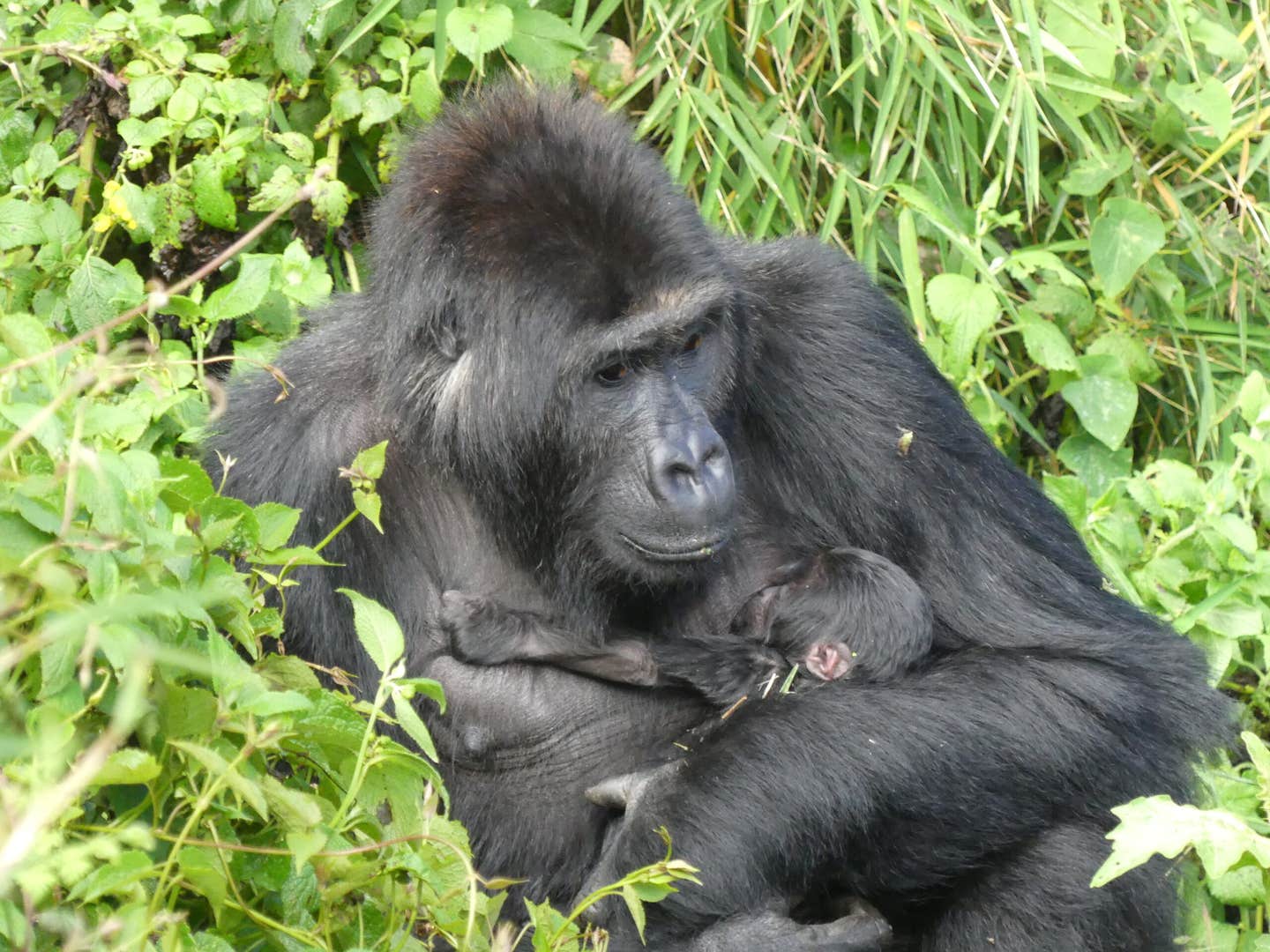
One of the first-ever eastern lowland gorillas to be successfully returned to the wild gave birth May 21 in Virunga National Park in the Democratic Republic of the Congo (DRC), marking a major milestone for an ambitious effort to reinforce a small and isolated population of the critically endangered primate.
The mother, Lulingu, was one of four female gorillas moved at the end of 2024 from the GRACE sanctuary in Kasugho to Virunga’s Mt. Tshiaberimu. Her baby was fathered by Mwasa, a wild silverback living on the mountain, a sign that Lulingu had successfully integrated into the wild population. The release of the four females, all of whom have joined Mwasa’s family group, was the culmination of a more than five-year rewilding process led by GRACE, Virunga National Park and local communities, with support from Gorilla Doctors and Re:wild.
“This is a milestone for the gorillas,” said Katie Fawcett, executive and science director of GRACE Gorillas. “They’ve adjusted to living in the wild extremely well so far, but raising an infant in the wild can be a challenge even for experienced mothers. We’re cautiously optimistic that Lulingu will navigate motherhood well and that the baby will continue to survive. No matter what happens, this is another historic first for eastern lowland gorilla conservation.”
The Congolese nature authority (ICCN) and Gorilla Doctors rescued Lulingu at just 18 months old after she was taken from her family and sold into the illegal wildlife trade. She was the youngest orphaned gorilla ever brought to GRACE, the only sanctuary in the world for rescued eastern lowland gorillas (also known as Grauer’s gorillas).
GRACE provided Lulingu with around-the-clock care before another gorilla, Pinga, took over as her surrogate mother and welcomed her into the larger gorilla family at GRACE. That family included Mapendo, Ndjingala and Isangi--the other three females who would eventually return to the wild alongside Lulingu.
“I have been with GRACE since the beginning. Lulingu's journey reflects everything we hoped possible,” said Jackson Kabuyaya Mbeke, DR Congo country director for GRACE. “I watched her arrive as our youngest orphan at 18 months old, grow up in a surrogate gorilla family, return to the wild, and now become a mother for the first time. This milestone is the result of years of hard work—day and night. I am deeply proud of our team and grateful to everyone involved.”
The birth is also an important step toward the conservation project’s central goals: providing a critical genetic boost to the small and isolated gorilla population on Mt. Tshiaberimu. A population viability analysis that modeled the population’s future found a high probability that the gorillas would go extinct within 50 years unless reproductive females were added to the population.
Isangi, Lulingu, Mapendo and Ndjingala were rescued from the illegal wildlife trade as infants and were the first gorillas from the GRACE sanctuary to be rewilded. A team from GRACE Gorillas, Virunga National Park and Gorilla Doctors, largely informed and guided by the expertise of GRACE caregivers, evaluated and selected the four females based on their behavior, reproductive health and overall health. The process followed best practice guidelines developed by the International Union for the Conservation of Nature (IUCN) for the reintroduction of great apes.
A gorilla monitoring team has been tracking the family group closely since the four females were released into the wild in December 2024 and has observed them mating with Mwasa. In addition to monitoring the gorillas’ feeding behavior, the team has been collecting urine samples non-invasively from leaves and using human pregnancy tests to detect elevated levels of hormones associated with pregnancy.
“None of the four females have required veterinary treatment for illness or injury since being rewilded--the outcome we always hope for,” said Dr. Cedric Kibengo, a field veterinarian with Gorilla Doctors who has monitored the health of all the eastern lowland gorillas at Mt. Tshiaberimu since 2024. "With the arrival of Lulingu's infant, we now have one more 'patient' under our care, and both mother and infant are healthy and doing well.”
Lulingu has already navigated a series of firsts since returning to the wild, adapting to a new habitat, diet, and social environment. These successes have made the monitoring team optimistic as she navigates another first: raising an infant.
Researchers have not studied eastern lowland gorilla mortality rates in the wild, but the mortality rate for closely related mountain gorilla infants is about 35%. Although all four females interacted with young gorillas while living at GRACE, none has raised an infant before. The monitoring team hopes the gorillas will learn with and from one other as they begin raising young in the wild.
“Lulingu is doing a great job taking care of the baby and is central to the family group,” said Benoit Ishaba, head of gorilla monitoring on Mt. Tshiaberimu and a ranger at Virunga National Park. “We have seen her nursing, cradling, and playing with the baby. The other young gorilla in her group has shown interest in the baby, and Lulingu has been very patient with him.”
Lulingu’s new infant is also giving scientists and conservationists a rare opportunity to observe a rewilded eastern lowland gorilla raising her first infant and to better understand how the reintroduced females respond to and interact with a new baby.
Gorilla pregnancies typically last between eight and nine months. At least one of the other rewilded females may also be pregnant and could give birth in the coming weeks or months.
“As Lulingu’s baby grows, this new life offers renewed hope for the small, isolated gorilla population on Mt. Tshiaberimu and for the future of eastern lowland gorillas across their range. Each healthy infant represents more than an addition to the population—it is a sign of resilience, recovery, and what is possible through long-term care, collaboration, and targeted protection,” said Mary Brown, Re:wild’s Africa program lead.
The partners will continue to closely monitor Lulingu and her baby as they take their place in the future of this critically endangered primate.
Additional quotes
Laura Parker, head of conservation programs, Virunga National Park
“Lulingu’s infant is an incredibly important moment for Tshiaberimu. When we began this reinforcement, the hope was not simply that these females could adapt to life in the wild, but that they could become part of this population and contribute to its future. Seeing Lulingu now raising an infant of her own is a wonderful step toward that goal. Every individual matters and this birth gives us real reason for hope.”
Damien Caillaud, associate professor of UC Davis, GRACE scientific advisor, and member of Rewilding Project Advisory Committee
“We are thrilled to see more than a decade of planning, guided by more than 20 experts across behavioral and genetic science, husbandry, veterinary care, species monitoring and other disciplines, lead to this extraordinary moment of hope for the species. And the impact doesn’t stop here: what we learn from Lulingu and the other rewilded gorillas will deepen our understanding of this critically endangered species.”
# # #
Photo: Eastern lowland gorilla Lulingu with baby in Virunga National Park’s Mt. Tshiaberimu in May. (Photo by GRACE Gorillas)
GRACE Gorillas
The Gorilla Rehabilitation and Conservation Education Center (GRACE Gorillas) partners with Congolese communities to create a living landscape where gorillas, forests, and people thrive. Based in eastern Democratic Republic of the Congo, GRACE operates the world’s only sanctuary for critically endangered Grauer’s gorillas rescued from the illegal wildlife trade. GRACE is innovating efforts to reintroduce gorillas to the wild, protect 500,000 acres of primary forest, and engage more than 60,000 people annually in community-led conservation. Learn more at www.gracegorillas.org.
Virunga National Park
Virunga National Park, located in eastern Democratic Republic of the Congo, is a protected area spanning 7,800 square kilometers between the Congo Basin and the biodiverse landscapes of East Africa. The park was established in 1925 as Africa’s first national park and has been a UNESCO-designated World Heritage Site since 1979. In recent years, poaching and the two Congo Wars have severely damaged its wildlife population. The park is managed by the Congolese nature authority (ICCN) and its partner Virunga Foundation.
Institut Congolais pour la Conservation de la Nature (ICCN)
The ICCN is a Congolese governmental partner tasked with the protection and conservation of a number of protected areas in the Democratic Republic of the Congo, including Virunga National Park and Kahuzi-Biega National Park, both UNESCO World Heritage Sites. In these sites, members of the ICCN are charged with the overall protection of the parks and the endangered mountain and eastern lowland gorillas.
Gorilla Doctors
Gorilla Doctors is the only organization conserving wild eastern gorillas (mountain and Grauer’s) across DR Congo, Rwanda, and Uganda with life-saving veterinary medicine and science using a One Health approach. Since 1986, we have championed the understanding that the health of people, gorillas and our shared environment are interconnected. To that end, Gorilla Doctors' wildlife health surveillance serves as an early warning system for detecting emerging pathogens. Learn more at: www.gorilladoctors.org.
Re:wild
Re:wild protects and restores the wild. We have a singular and powerful focus: the wild as the most effective solution to the interconnected climate, biodiversity and human wellbeing crises. Founded by a group of renowned conservation scientists together with Leonardo DiCaprio, Re:wild is a force multiplier that brings together Indigenous peoples, local communities, influential leaders, nongovernmental organizations, governments, companies and the public to protect and rewild at the scale and speed we need. Learn more at rewild.org.
Contact
Lindsay Renick Mayer
lrenickmayer@rewild.org
+1 512-686-6225
Laurie Cummins
lcummins@gracegorillas.org
+1 734-834-4439
Amy Bond
abond@gorilladoctors.org
Nick Colwell
ncolwill@virunga.org

Lindsay Renick Mayer
Director of Communications and Impact Campaigns
Lindsay is the Director of Communications and Impact Campaigns for Re:wild and has a particular interest in leveraging communications to inspire conservation action. Lindsay is passionate about species-based conservation and finding compelling ways to tell stories that demonstrate the value of all of the planet’s critters, big and microscopic.