Most Wanted Lost Species
More than 4,300 species are lost to science--and we would love to find every one of them again alongside local partners. Re:wild’s Most Wanted Lost Species list spotlights a diverse group that represents the breadth of species still waiting to be rediscovered and, where possible, those with the greatest potential to drive conservation.
These species represent a wide range of habitats, regions and taxa, they have cultural value and have compelling stories to tell. Some already have local teams actively searching for them. For others, scientists and conservationists stand ready to mobilize a search. Some have been lost for decades, while others have become lost to science much more recently. For each species, we prioritize partnerships with local communities, organizations, and conservationists.
When species are rediscovered, we rotate it off the most wanted list and add a new lost species in its place, keeping the list representative of the extraordinary diversity of life that remains lost to science and creating new opportunities to search, learn and safeguard these species and their ecosystems.
The Search for Re:wild's Most Wanted Lost Species is supported by Colossal Foundation and other donors.
Discover the most wanted lost species below, or use the links to go straight to any profile.
Blanco Blind Salamander | Bullneck Sea Muppet | Dwarf Hutia | Fat Catfish | Himalayan Quail | Ice Star | Ilin Island Cloudrunner | Miss Waldron’s Red Colobus | Namdapha Flying Squirrel | New Zealand Greater Short-tailed Bat | Pink-headed Duck | Pondicherry Shark | Scarlet Harlequin Toad | Similar Firefly | South Island Kōkako | Togo Mouse | Sinú Parakeet | Syr Darya Shovelnose Sturgeon | Voandrozana Tree | Zugs’ Monitor

Blanco Blind Salamander
Scientific Name: Eurycea robusta
Last Seen: 1951 in Texas, United States
Red List Status: Data Deficient
The Blanco Blind Salamander is so rare that it has only been found once—in a spot just northeast of San Marcos, Texas. Workers discovered the species in 1951 while excavating a small crevice with flowing water in the bed of the then-dry Blanco River. Only four individuals were found. Since then, the river has changed course, and gravel and sediment have buried the spring where they were discovered.
The good news is: If any species could survive being sealed beneath a riverbed, it would probably be the Blanco Blind Salamander. This underground species breathes through its gills, lacks pigmentation, and likely preys on groundwater invertebrates and even other salamanders in the aquifers where it lives.
Declining groundwater quality and quantity, contamination and its extremely limited known range all threaten the species. With partners already searching, we hope to find out whether the Blanco Blind Salamander is still holding on underground!

Bullneck Sea Muppet
Scientific Name: Australyichthys minotaur
Last Seen: Last collected in 1996, from Australia
Red List Status: Data Deficient
No scientist has ever seen a Bullneck Sea Muppet in the wild. This tiny seahorse, only about two inches long, is known from just four specimens collected from deep waters off the coast of Eden, Australia.
Scientists know almost nothing about the Bullneck Sea Muppet’s population, distribution, ecology, behavior or life history. They believe it lives in sand beds at the bottom of the ocean (more than 325 feet underwater) among gorgonian corals. Dedicated field surveys require scuba diving and fisheries sampling.
Update: In 2024, Re:wild and Oceanreef Aquaculture visited eight coastal communities and spoke with more than 100 fishers, divers, and others, uncovering accounts from two fishers who believe they saw a Bullneck Sea Muppet decades ago. Those interviews are now helping researchers narrow down where to conduct these expeditions.

Dwarf Hutia
Scientific Name: Mesocapromys nanus
Last Seen: 1937 in Cuba
Red List Status: Critically Endangered (Possibly Extinct)
One of the first mammals to be described from fossils before scientists found it alive, the Dwarf Hutia looks like a guinea pig–esque rodent that once lived across Cuba and the nearby Isle of Youth. Researchers last captured one in 1937, although some suspicious droppings found in 1978 raised hopes that the species might still survive.
If it does, the Dwarf Hutia most persists in the uber-remote Zapata Swamp, and there may only be a handful left. Unlike many rodents that produce large litters, a Dwarf Hutia once kept in captivity gave birth to just one baby.
What wiped these little guys out? The species has faced a long list of threats. Invasive Black Rats compete with it for habitat and food, while mongooses and invasive Walking Catfish prey on them and other native wildlife in the Zapata Swamp. Habitat destruction and fires have put additional pressure on the species.
Finding the Dwarf Hutia will require better surveys of the swamp and efforts to manage its invasive species.

Fat Catfish
Scientific Name: Rhizosomichthys totae
Last Seen: 1957 in Colombia
Red List Status: Critically Endangered (Possibly Extinct)
What’s in a name? ‘Fat Catfish’ almost says it all. This lost fish species has more rolls than a used tire. The Fat Catfish has only ever been found 9,800 feet high in the Andes mountains, in Lake Tota, where locals call it “Pez Graso,” which can also be translated to “grease fish” — a name, perhaps, both apt and foreboding for a combustible fish. Yes, you read that right. Before the Fat Catfish became a lost species, local people sometimes burned its fat for fuel in their lamps. The mystery of their disappearance, however, remains unanswered.
The Fat Catfish was first described by ichthyologist Cecil Miles in 1942, and the last known individual was collected from the wild in 1957. Only nine other individuals had been recorded before then. Scientists still know remarkably little about its biology, including what it eats, how it grows or exactly where within Lake Tota and its surrounding waterways it might live.
Update: Researchers and local partners have been narrowing the search by combining community interviews, historical research and field surveys. Their work identified several promising sites in and around Lake Tota, where researchers conducted environmental DNA and other survey techniques to look for evidence that the Fat Catfish survives.

Himalayan Quail
Scientific Name: Ophrysia superciliosa
Last Seen: 1876 in India
Red List Status: Critically Endangered
Himalayan Quails have distinctive red bills and legs, black faces and throats with white foreheads. They rarely fly, and usually only when flushed. This medium-sized quail belongs to the pheasant family and is known from only two locations in India.
The species was first described in 1846 by J. E. Gray from living individuals in the collection of the Earl of Derby at Knowsley Hall. It was not found in the wild until 1865, when Kenneth Mackinnon shot a pair of quails. It was last seen only about a decade later.
The Himalayan Quail is also one of the most wanted lost birds by the Search for Lost Birds, a collaboration between Re:wild, American Bird Conservancy and BirdLife International.
Update: Researchers have combined forces with birding tour operators to extend the search into the Himalayan foothills. Community questionnaires are helping to narrow down the search to key sites where camera traps will be deployed in the hope to capture this elusive bird.

Ice Star
Scientific Name: Paralophaster ferax
Last Seen: 1963
Red List Status: Not Evaluated
In the 1960s, scientists pulled an extraordinary starfish from the Southern Ocean off the coast of Antarctica. Unlike any other known species of its kind, the Ice Star raises its young inside a special body cavity called the coelom before giving birth through its…mouth.
This special kind of deep-sea starfish wasn’t scientifically described (or officially confirmed as its own species), until 2023, when a scientist from the Smithsonian National Museum of Natural History revisited an uncatalogued collection of starfish gathered by a research vessel from the Southern Ocean 60 years earlier. The Ice Star can live more than 14,500 feet below the ocean’s surface.
Starfish play important roles as predators in ocean ecosystems and can even push their stomach outside of their mouth to help them catch unsuspecting prey larger than itself. The rediscovery of this species would allow scientists to compare living individuals with those collected in the ‘60s, helping researchers better understand the effects of a warming ocean on deep-sea life. Finding this lost species is going to take some deep-sea navigation and creativity, but we’re still hopeful it is at home in the Antarctic waters.
Illustration by Mauricio Alvarez.

Ilin Island Cloudrunner
Scientific Name: Crateromys paulus
Last Seen: 1953 in the Philippines
Red List Status: Data Deficient
The Ilin Island Cloudrunner is only known from a single individual purchased at a market on the Philippines’ Ilin Island in 1953. Decades later, scientists recognized the individual as a distinct species while examining the collection at the Smithsonian National Museum of Natural History.
Although surveys with local communities have not revealed knowledge of the species, there are some unverified reports from Mindoro. Scientists don’t know much about the cloudrunner’s habitat or ecology, but believe it may depend on the island’s remaining lowland forest, possibly including the increasingly rare Philippine Teak.

Miss Waldron’s Red Colobus
Scientific Name: Piliocolobus waldroni
Last Seen: 1978 in Côte d'Ivoire
Red List Status: Critically Endangered (Possibly Extinct)
The species was first discovered in 1933 by a British museum collector who named it after a colleague on the expedition, Miss F. Waldron. The last conclusive sighting of the monkey was in 1978. No photographs or video of the species alive exist.
Although the quest to find Miss Waldron’s Red Colobus Monkey with partners the Swiss Center for Scientific Research in Côte d’Ivoire and Florida Atlantic University has not yet uncovered photographic evidence of the monkey in question, it has produced striking footage of other rare and endangered primates. This includes the Critically Endangered White-thighed Colobus, Endangered White-naped Mangabey, and the first-ever video of a Critically Endangered Roloway Monkey in the wild, captured high in the canopy of Côte d'Ivoire’s Tanoé-Ehy Forest in west Africa.

Namdapha Flying Squirrel
Scientific Name: Biswamoyopterus biswasi
Last Seen: 1981 in India
Red List Status: Critically Endangered
The Namdapha Flying Squirrel is only known with certainty from a single individual collected in Namdapha National Park, the largest protected area in the Eastern Himalaya biodiversity hotspot,.
Scientists believe this Critically Endangered squirrel lives in riverine forest and may occupy an extremely restricted range within the park. Several searches have produced possible sightings over the years, but confirming its identity is especially challenging because the Red Giant Flying Squirrel lives in the same area and looks remarkably similar.
Update: After 10 expeditions and 79 days of searching, an Aaranyak-led team photographed flying squirrels they believe could be the Namdapha Flying Squirrel. The images aren’t enough to confirm a rediscovery, so researchers are working to obtain DNA from fur, scat or saliva that could finally determine whether the lost species has been found.

New Zealand Greater Short-tailed Bat
Scientific Name: Mystacina robusta
Last Seen: 1967 in New Zealand
Red List Status: Critically Endangered (Possibly Extinct)
If the New Zealand Greater Short-tailed Bat still exists, it could be the conservation come-back kid. This species—one of three of New Zealand’s bat species—vanished from New Zealand’s North and South islands following European arrival some 200 years ago. It was subsequently restricted to small predator-free islands until rats were accidentally introduced in 1963.
Because this bat spends an unusual amount of time on the ground, it’s especially susceptible to rats, and the introduction of the invasive species devastated the bat’s remaining population. Rats have since been eradicated from both Big South Cape and neighboring Putauhina Island, and since then there have been several unconfirmed sightings in both places. In 1999, researchers even recorded Mystacina-like echolocation calls on Putauhina, leaving hope that the species may still survive.

Pink-headed Duck
Scientific Name: Rhodonessa caryophyllacea
Last Seen: 1949 in India
Red List Status: Critically Endangered
The Pink-headed Duck was always considered rare, but it has not been conclusively seen in the wild since 1949 in India and is known from Myanmar from only two individuals. Unconfirmed reports of Pink-headed Duck sightings in 2006 spurred conservationists to continue to look for it and to try to capture the first photos of a live bird, unsuccessfully. In addition to the deep pink head and neck found on male ducks, these birds lay spherical eggs and might live in tall, thick elephant grasslands, swamps and floodplains.
Update: During a 2017 expedition in Myanmar’s Kachin State, researchers did not find the duck, but interviews with local residents produced several intriguing accounts. Those reports suggest Pink-headed Ducks may have survived around the Naung Kwin wetland and Indawgyi Lake far more recently than Myanmar’s last confirmed record in 1910, although none of the accounts could be verified.

Pondicherry Shark
Scientific Name: Carcharhinus hemiodon
Last Seen: 1979 in India
Red List Status: Critically Endangered
The Pondicherry Shark is a small and stocky gray shark that grows to only about three feet (one meter) long. It was once found across Indo-Pacific coastal waters, from India and possibly extending to the Gulf of Oman into Southeast Asia.
The species can also enter freshwater and may be found in rivers including the Hooghli River and Saigon. Despite its once-broad range, the Pondicherry Shark has not been conclusively documented since 1970. Finding it again would give scientists a chance to understand where it survives and what threats it faces across some of the world’s most heavily used coastal and river ecosystems.
Update: Field teams in both India and Sri Lanka are using a variety of field techniques, from eDNA to underwater filming devices, as well as visiting fishing markets and interviewing fishermen, to search for evidence of the Pondicherry sharks across key sites.

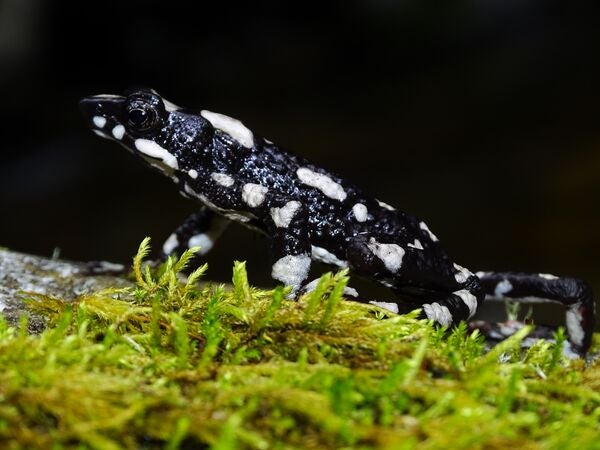
Scarlet Harlequin Toad
Scientific Name: Atelopus sorianoi
Last Seen: 1990 in Venezuela
Red List Status: Critically Endangered (Possibly Extinct)
Once one of the bright jewels of Venezuela’s cloud forests, the Scarlet Harlequin Toad flashed brilliant orange along the streams of the Venezuelan Andes. Then the chytrid fungus swept through Central and South America, devastating harlequin toads and other amphibians in its path. The Scarlet Harlequin Toad has been lost to science since 1990 as a result.
Rediscovering the Scarlet Harlequin Toad could help scientists better understand how amphibians can persist--or potentially rebound--The rediscovery of this lost toad could be the key to better understanding how species rebound from the infectious disease.
Most harlequin toads live along mid- to high-elevation streams, and about 40% of Atelopus species have disappeared from their known homes. The Scarlet Harlequin Toad has the most restricted geographic range of any Venezuelan Atelopus species, known from just a single stream in an isolated cloud forest.
Update: Since 2020, the Atelopus Venezuela Working Group has searched for the Scarlet Harlequin Toad alongside local students, combining scientific surveys with the memories of community elders who remember the bright orange frogs once filling local streams. The team has not yet found the toad, but rediscovering it could help conservationists understand how some harlequin toads have survived chytrid—and give them the chance to protect one of Venezuela’s lost jewels.

Similar Firefly
Scientific Name: Pyractomena similis
Last Seen: 1983
Red List Status: Data Deficient
When male Similar Fireflies flash their unique sequence of short, amber-colored, amorous lights, they’re advertising their availability to the females watching carefully for something they like from the ground below. For Re:wild and our partners, observing this particular call sign will be even more monumental: it could be a pivotal part of confirming the rediscovery of this lost firefly.
Before its last scientific documentation in 1983, this species had been recorded in Maryland, Virginia, South Carolina, Alabama and Mississippi. Searches in North Carolina and Georgia and have so far failed to find it.
The species seems to have lived in open fields near rivers, including agricultural lands, but not much else is known about it. Its rediscovery could help entomologists and conservationists understand where it currently lives, what kind of habitat it prefers, its ecology, and the threats to its survival. The biggest threat to all species of fireflies of —emblems of American summerhood—is habitat destruction.
Illustration by Mauricio Alvarez.

South Island Kōkako
Scientific Name: Callaeas cinereus
Last Seen: 2007 in New Zealand
Red List Status: Critically Endangered (Possibly Extinct)
The South Island Kōkako was last documented in 2007, which makes it one of the most recently documented species on the most wanted list. The South Island Kōkako, also known as the Orange-wattled Crow, made headlines in 2007, the last officially accepted sighting of the species. The accepted record before that was in 1967. Based on this sighting, in 2013, the New Zealand Department of Conservation overturned its 2008 decision to declare the species Extinct.
The South Island Kōkako is known for its haunting, melancholy yet melodious song, with calls that include rich flute and organ notes. If it is rediscovered, New Zealand conservationists believe its recovery can bring it back from the brink of extinction in the same way they helped revive its sister species, the North Island Kōkako, and other native birds including the Kākāpō, Takahē, Black Robin and the Chatham Taiko.
The South Island Kōkako is also one of the most wanted lost birds by the Search for Lost Birds, a collaboration between Re:wild, American Bird Conservancy and BirdLife International.
Update: In 2023, teams searching Abel Tasman and Kahurangi national parks recorded several promising calls that could have come from South Island Kōkako, although none provided conclusive evidence. Researchers continue to explore acoustic analysis and environmental DNA as potential ways to finally confirm whether the bird survives.

Togo Mouse
Scientific Name: Leimacomys buettneri
Last Seen: 1890 in Togo/Ghana
Red List Status: Data Deficient
The Togo Mouse is known from just two individuals collected at a single location in 1890. Those two individuals provide nearly everything scientists know about its natural history. Evidence from their teeth and stomachs suggests the mouse eats insects, while its short tail indicates that it probably lives on the ground rather than in the forest canopy. Researchers think the Togo Mouse may occupy parts of Ghana, as well as Togo.
Two expeditions failed to rediscover the Togo Mouse in the 1990s. More recent interviews, however, suggest that people in both Togo and Ghana may recognize the animal. Hunters in Ghana reported knowledge of the mouse as recently as 2011. The hunters believe that their activities caused several local small mammal populations to fall, including Togo Mice. Field staff in the Kyabobo Range National Park, 12 miles west of the site of the Togo Mouse’s original discovery, also say they recognize the species when shown pictures, as do locals, calling it “Yefuli.”
With 80% of West Africa’s rainforests degraded or cleared for agriculture, surveys of remaining forest in both countries are urgently needed to determine whether the Togo Mouse still survives and to protect its habitat if it does.

Sinú Parakeet
Scientific Name: Pyrrhura subandina
Last Seen: 1949 in Colombia
Red List Status: Critically Endangered (Possibly Extinct)
This beautiful tropical parakeet is only known with certainty from the Sinú Valley in northern Colombia. BirdLife International estimates that if the bird is not already extinct, no more than 50 likely exist. Despite extensive searches, there have been no confirmed records of the parakeet since 1949.
Scientists know very little about the Sinú Parakeet’s reproductive physiology, nutritional needs, ecology or behavior. Of the four locations in Colombia where the species was once known, two have been deforested. But underexplored forests in the Alto Sinú region continue to give conservationists reason to search.
Update: For seven years, Colombian biologist Yulisa Navarro and the Sociedad Ornitológica de Córdoba have led searches across Alto Sinú, combining historical research, ecological modeling, field expeditions and local knowledge. The parakeet has not yet been found, but in 2021 they documented 22 species of birds that had not been known to live in the Murrucucú Mountains previously. In 2026 the team received new support to refine its search using priority habitat models, acoustic monitoring and potentially environmental DNA.

Syr Darya Shovelnose Sturgeon
Scientific Name: Pseudoscaphirhynchus fedtschenkoi
Last Seen: 1960s in Kazakhstan
Red List Status: Critically Endangered (Possibly Extinct)
The striking Syr Darya Shovelnose Sturgeon is found nowhere else on Earth but the Syr Darya River, and was once found in Kazakhstan, Tajikistan and Uzbekistan. It is among the smallest sturgeon species in the world, growing only up to about one foot long. It was once found in the Aral Sea, but according to NASA, the Aral Sea shrunk by more than 60% between 1973 and 2000.
The Aral Sea is now hypersaline and as a result, doesn’t harbor any fish, aside from in a small reservoir. The river has also experienced large levels of water extraction, damming and agricultural pollution.
The sturgeon has been listed in the Red Data Book of Kazakhstan since 1978 and has also been featured on stamps. The Syr Darya Shovelnose Sturgeon is also one of the \most wanted freshwater fishes by the Search for Lost Fishes, the freshwater-fish focused initiative of Re:wild’s Search for Lost Species program, in partnership with Shoal.
Update: An expedition in Kazakhstan did not rediscover the sturgeon, but researchers found stretches of suitable habitat supporting a surprising diversity of fish. Local fishers also described possible catches as recently as 2017, including the species’ distinctive long, whip-like tail, giving researchers new locations and leads for continued searches.

Voandrozana Tree
Scientific Name: Schizolaena capuronii
Last Seen: 1954 in Madagascar
Red List Status: Endangered
Madagascar’s Makira Forest—he largest forest on the island—has led to the rediscovery of a treasure trove of lost species in previous years and we’re hoping to have similar success with the lost Voandrozana Tree. This species is known only from a single individual collected in 1954 and wasn’t even given a scientific name until 45 years after its discovery.
We don’t know much about it. We don’t know what color its flower is, why it seems to have fewer leaves than other related Schizolaena trees and shrubs—all of which are found only on Madagascar—or whether it is even its own species. What we do know is limited: it is about 65-82 feet tall (20-25 meters), grows in humid mid-elevation evergreen forest, is pollinated by insects, and its seeds are dispersed by lemurs, bats and birds.
Its rediscovery is a race against time as agriculture, exploitation of the forest and fires threaten its known habitat. A Search for Lost Species expedition in 2024 to Makira found more than 20 lost species, including three iridescent and nearly translucent species of fish and a giant millipede that had been lost to science for 126 years.

Zugs’ Monitor
Scientific Name: Varanus zugorum
Last Seen: 1980 in Indonesia
Red List Status: Data Deficient
Except for one or two individuals imported for the pet trade, almost nothing is known about Zugs’ Monitor. Local people report rarely—if ever—seeing it, and scientists know nothing about its ecology, behavior or natural history.
It species comes from the Moluccan Islands of East Indonesia, where the number of new Varanus species discovered has increased significantly in recent years. The rainforests of Halmahera Island are a biodiversity hotspot and home to several endemic species. Dedicated surveys could determine whether Zugs’ Monitor is among the island’s surviving endemic species and begin to reveal how it lives and what it needs to survive.
Explore More About Lost Species
Continue your journey to learn how lost species are found, why they disappear, and the full scope of our search efforts.