Quy Tấn Lê is a researcher affiliated with both the Institute of Advanced Technology and the Southern Institute of Ecology in Viet Nam. Since 2017, as an undergraduate, he has been involved in fieldwork for conservation projects in Viet Nam, primarily on biodiversity monitoring using camera-trapping. Quy was part of the team that rediscovered the Silver-backed Chevrotain in 2017. Since then, he has taken a leading role in conservation efforts for the species, supported by the guidance of mentors in Viet Nam and around the globe. Although based in Ho Chi Minh City, Quy spends much of his time in the field and finds great satisfaction in reviewing camera-trap images to uncover hidden wildlife activity.
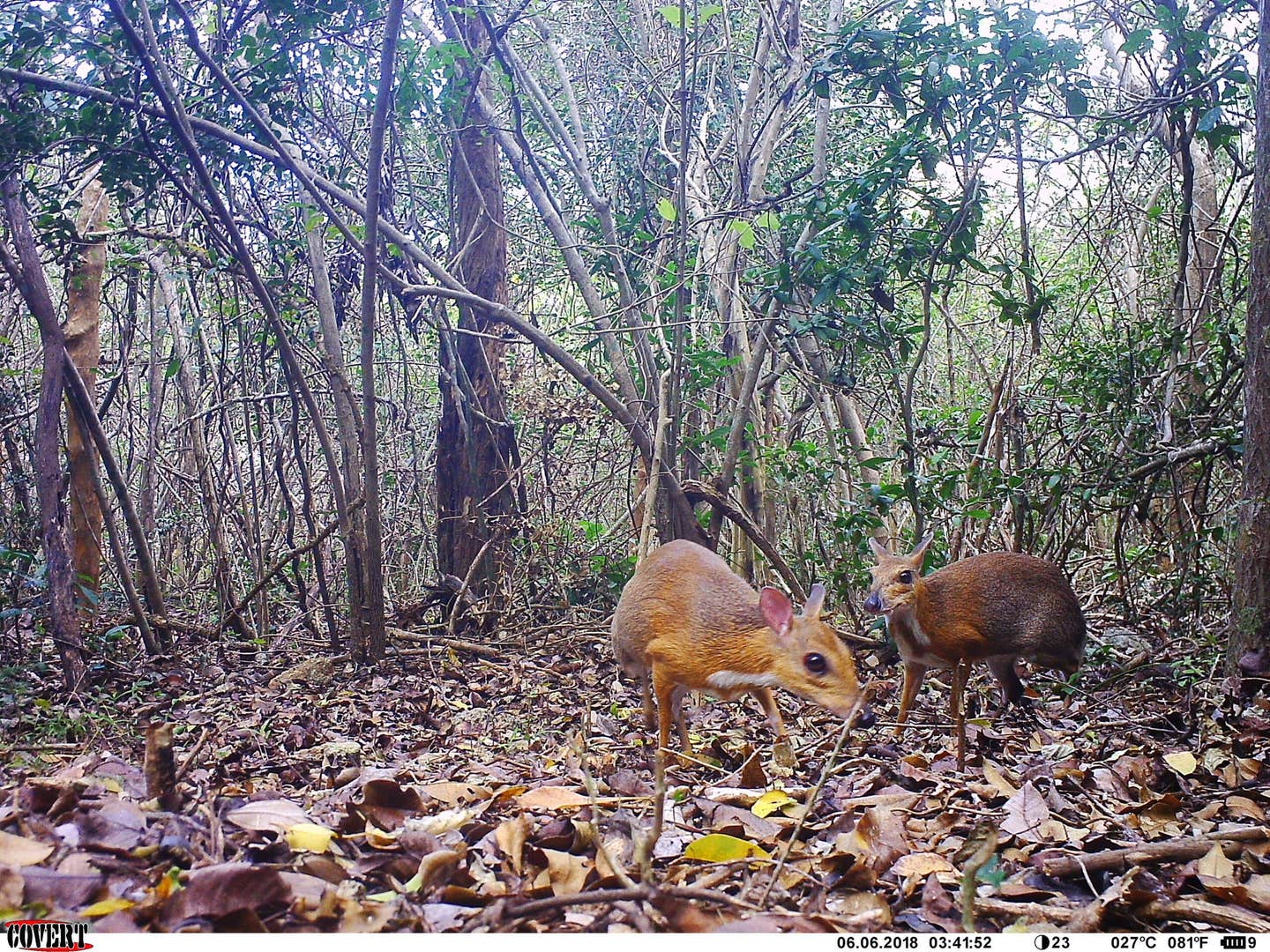
For nearly 30 years, the Silver-backed Chevrotain was considered lost to science. Then, in 2017, researchers in Viet Nam rediscovered the tiny, silver-furred mammal and captured the first-ever photographs of it in the wild.
Its return offered a rare conservation success story—and a reminder that even species on the brink can get a second chance. For Lost Species Month, conservation researcher Quy Lê Tấn shares the story behind the rediscovery and why this remarkable little animal is still fighting for its future.
What exactly is a Silver-backed Chevrotain? How did it get its name?
Imagine a tiny deer without antlers, that’s the best way to picture a chevrotain”. Chevrotains, or mousedeers as they are also called, are the world’s smallest hoofed mammals. Despite the name, it’s neither a rodent nor a true deer. Instead, it belongs to a distinct branch of hoofed mammals that includes giraffes, antelopes, and deer. Among the 10 recognized species of mousedeer, the Silver-backed Chevrotain is unique. More than half of its upper back is covered in silvery fur tipped with white, giving it a striking appearance unlike any of its relatives. It is also special because it has one of the smallest ranges of any chevrotain, and more surprisingly, for almost 30 years it was considered a “lost species”.

How rare is this species, and why is it so hard to find?
The Silver-backed Chevrotain is one of the world’s rarest and most elusive ungulate species. It was described by science in the early 1900s, then disappeared for 80 years. In 1990, a single skin was found and suggested that it still existed. Then it vanished again. In 2015, the Silver-backed Chevrotain was put on the “Top 25 Most Wanted” on Re:wild’s Search For Lost Species initiative.
Over the next two years, scientists from the Southern Institute of Ecology, Nui Chua National Park, Re:wild, and the Leibniz Institute for Zoo and Wildlife Research tried to find the species, and succeeded. In 2017, the team captured the first-ever photographs of the Silver-backed Chevrotain in the wild, and provided the first evidence in many years that it persisted. Today, the species survives only in lowland tropical dry forests, an ecosystem that’s rapidly disappearing due to deforestation, infrastructure development, and human settlement.
These forests are among the most overlooked and least protected in Viet Nam. Hunting pressure is intense across its known range, and the chevrotain is caught for food and the pet trade. Researchers have identified just six isolated populations in central Viet Nam. Four populations are dangerously small. Unfortunately, this newly-discovered species is very close to being lost for good.
How do researchers track or monitor small, elusive animals in dense forests?
Due to its elusive nature and rarity, observing the Silver-backed Chevrotain directly is extremely difficult. Almost everything that we know about the species comes from photos and videos captured by heat- and motion-triggered cameras. These devices allow researchers to study the animal indirectly, thus minimizing human disturbance to its natural habitat.
Back in 2017, before the species had been rediscovered, the vastness of the forest and the lack of ecological data made it difficult to identify suitable locations for camera deployment. At that time, local knowledge proved invaluable. Members of the Raglai ethnic community, with their deep understanding of the lowland coastal dry forests, helped the team to select promising sites to set up camera-traps for Silver-backed Chevrotain. Thus, the use of local ecological knowledge was critical to our initial efforts to find the species. Today, with more data available on the species’ distribution, we can monitor its status more effectively by systematically placing camera traps across its preferred habitats.

Why should the survival of a creature most people have never heard of matter to all of us?
Despite its small size, the Silver-backed Chevrotain plays an important role in keeping its ecosystem healthy. It feeds on fallen fruits and young leaves, and as it moves through the forests, it spreads seeds from different trees. This natural seed dispersal helps forests grow back, keeps plant life diverse, and enriches the soil, thus maintaining the overall health of the dry coastal forest and benefiting countless other species. If animals like the Silver-backed Chevrotain disappear, forests lose their ability to regenerate naturally. And that makes these forests more susceptible to external threats like deforestation and climate change. Local communities would also be affected, losing access to wild herbs and plants used for food and traditional medicine.
The Silver-backed Chevrotain is therefore a small but mighty player in keeping the forests of Viet Nam healthy. And the forests of Viet Nam are, in many ways, the “lungs of mainland Southeast Asia”, and therefore integral to the health of the wider region. Finally, there is the moral imperative to protect a species that has evolved over millions of years.
What does it feel like to be part of a rediscovery of a species thought to be lost forever?
It was the most amazing feeling in the world. I felt incredibly fortunate and grateful for the chance to join the team. I was still an undergraduate majoring in Biology. Following my parents’ wishes, I had planned to become a hospital lab technician, although deep down I knew that was not what I wanted for the rest of my life. One day, two seniors visited my Zoology class and shared stories about fieldwork studying wild mammals in Viet Nam. I wanted something different, so I asked to volunteer for their fieldwork and joined them in setting up camera traps to try to confirm the Silver-backed Chevrotain’s existence.
At the time, I did not even know what a Silver-backed Chevrotain was. On the trip, I found a snared, dying muntjac and felt immense sympathy for the animal, knowing that without us it might still have been roaming free and that there was nothing we could do to save it in such a remote location without nearby expertise. From that moment, I was determined to do something to protect wildlife. When our cameras finally detected the Silver-backed Chevrotain, my commitment to conservation deepened. On my first trip into the forest, we found a species thought lost, and I felt my purpose shift; my career became entwined with this species and I am determined to do my very best to ensure its survival in harmony with its ecosystem. Without the Silver-backed Chevrotain and the seniors and forest guards guiding me to the forest for the first time, I would not have found my life’s meaning.
Are there any ongoing conservation efforts to protect this species?
A coalition of organizations has joined forces to protect the Silver-backed Chevrotain. By working together, we can amplify our impact to protect this unique species. The coalition members include Institute of Advanced Technology, Southern Institute of Ecology, Nui Chua - Phuoc Binh National Park, GreenViet, and the Center for Nature Conservation and Development in Viet Nam, with support from the IUCN Deer Specialist Group, Re:wild, and the Leibniz Institute for Zoo and Wildlife Research.
The coalition is focusing both on in-situ protection, which involves locating new populations and studying the species’ ecology to design effective threat-reduction measures, and ex-situ activities, which involves setting up a conservation breeding program for the species. The ex-situ aspect has developed a lot in the past year. Earlier this year, the world’s first conservation breeding program for the Silver-backed Chevrotain was launched in Nui Chua - Phuoc Binh National Park. The goal of the program will be to maintain an insurance population of the Silver-backed Chevrotain and eventually use it for future rewilding. The conservation breeding program also provides local employment. This combined in-situ and ex-situ approach maximizes conservation impact for the species and its unique dry forest ecosystem, but major challenges remain.
What’s the most surprising or unique thing about this species?
There are many reasons why the Silver-backed Chevrotain is unique. The species is restricted to Viet Nam, making it the country’s only endemic ungulate species. It also has one of the smallest geographic ranges of any hoofed mammal in the world. Many ungulate species span multiple countries or even continents – but the Silver-backed Chevrotain is found only in a tiny part of Viet Nam.
The Silver-backed Chevrotain is also unique because it is found exclusively in dry forests, which means that, unlike other chevrotain, it is a habitat specialist. As with other chevrotains, the males have visible canine “fangs” that they use to defend their territories and for fighting during breeding season. The fangs can grow quite long, and a mature male Silver-backed Chevrotain looks like a miniature vampire!
Much remains unknown about this species: its genetics, behavior, breeding patterns in the wild, and its responses to human disturbances, knowledge that is essential to inform captive-care strategies and effective conservation.

Why do some species slip through the cracks of conservation, even when the stakes are high?
It is unrealistic to expect conservation to save every threatened species. We should have tried our very best to protect more than the roughly 48,600 species currently listed as threatened, but resources are always limited, so priorities must be strategic and focused on preventing irreversible loss. Species that lack public appeal are often underfunded, so conservation planning needs to weigh extinction risk, endemism, and feasibility.
For example, in Viet Nam, the public admires tiger, leopard, rhino, and elephant, while lesser-known species, such as Saola, Large-antlered Muntjac, and Silver-backed Chevrotain, receive far less attention despite facing greater extinction risk because of their tiny ranges. The national disappearance of the Indochinese tiger could be reversed regionally (as the Indochinese tiger can still be found in Thailand and Myanmar), but the loss of the Silver-backed Chevrotain in Viet Nam would equate to global extinction, meaning that the species is gone forever.
Fortunately, support from conservation-minded organizations such as Re:wild, which has long invested in overlooked species, is shifting attention toward Viet Nam’s natural heritage. Many national NGOs are now working to protect range-restricted species such as Owston’s Civet, Viet Nam pheasant, and the country’s endemic primates.
Why is Lost Species Month important for raising awareness about animals like the Silver-backed Chevrotain?
Biodiversity news from Viet Nam and the broader Southeast Asia region is often marked by loss and despair, with the disappearance of iconic species such as the Kouprey, Vietnamese Javan rhinoceros, Indochinese tiger, and Indochinese leopard. In this context, stories of rediscovery offer a rare glimmer of hope and a renewed sense of optimism for the future. We should celebrate these stories. They are living proof of nature’s tenacity in the face of overwhelming odds.
Yet, we must also remain vigilant. History has shown us the fragility of such triumphs: after the excitement surrounding the rediscovery of the Javan rhinoceros in Viet Nam in the 1980s, the species was tragically declared extinct in the country in 2010. We cannot allow the Silver-backed Chevrotain to meet the same fate. Unlike the Javan rhinoceros, which still has a small surviving population in Indonesia, the Silver-backed Chevrotain exists nowhere else. If it vanishes from Viet Nam, it will be lost forever.
How can people help during Lost Species Month, and beyond?
The great thing about Lost Species Month is that anyone can be part of it – all you have to do is to stay informed and be engaged! There are several ways to help. First, you can use your voice to spread word about lost species to family and friends. We need everyone to help amplify the message around lost species and the amazing efforts to find and protect them.
Second, you can share underfrog stories on social media. This will help spotlight species that rarely get the mic. Use #LostSpeciesMonth + @rewild, and add a “why it matters” sentence and a link to learn more.
Third, you can join citizen science efforts to record biodiversity in your neighborhood. Outlets like iNaturalist are a great place to start. And who knows – you might be the next person to find a lost species!
And finally, you can stay in the loop by subscribing to our newsletter for rediscovery updates, field notes, and quick actions you can take. That way you can get the latest information on lost species and the efforts to protect underfrogs.
Quy Tấn Lê
Researcher
Quy Tấn Lê is a researcher affiliated with both the Institute of Advanced Technology and the Southern Institute of Ecology in Viet Nam. Since 2017, as an undergraduate, he has been involved in fieldwork for conservation projects in Viet Nam, primarily on biodiversity monitoring using camera-trapping. Quy was part of the team that rediscovered the Silver-backed Chevrotain in 2017. Since then, he has taken a leading role in conservation efforts for the species, supported by the guidance of mentors in Viet Nam and around the globe. Although based in Ho Chi Minh City, Quy spends much of his time in the field and finds great satisfaction in reviewing camera-trap images to uncover hidden wildlife activity.