
For release
Feb. 14, 2026
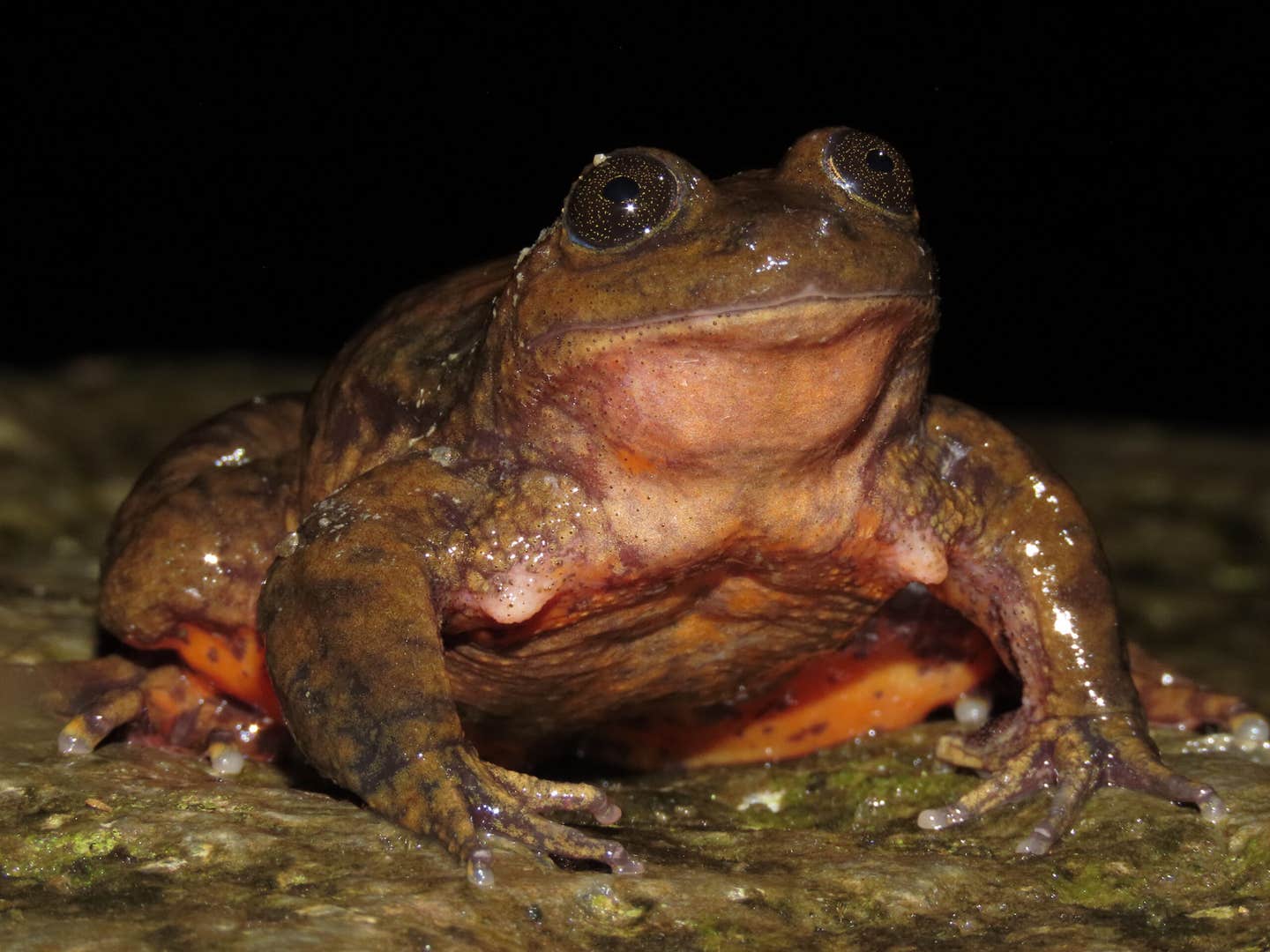
Herpetologists unexpectedly found a new population of Sehuencas water frogs (Telmatobius yuracare) in the wild in Bolivia. After receiving a tip from Saul Altamirano, a botanist working in the area, a group of herpetologists, led by Teresa Camacho Badani, visited a stream in Carrasco National Park in Bolivia to investigate if the critically endangered Sehuencas water frog was living in it. When the team arrived at the stream they found a small but stable population of Sehuencas water frogs. It is only the second population of Sehuencas water frogs found in the wild since 2009.
“Sometimes I feel that this species and I are somehow connected; it is very special to me,” said Teresa Camacho Badani, a herpetologist who also led an expedition in 2018 that discovered five Sehuencuas water frogs in a different stream in Carrasco National park. “The discovery of this new population renews our enthusiasm and hope for the conservation of the species, providing a critical opportunity to protect it in its natural habitat. Protecting the Sehuencas water frog’s home will also benefit other threatened species and may even give us the chance to rediscover species that have faced a similar fate and thought to be possibly extinct, such as the aquatic frogs Telmatobius edaphonastes and Telmatobius sibiricus.”
The team that discovered the second population of wild Sehuencas water frogs has been visiting the stream where they were found in Carrasco National Park regularly since January 2024. They have counted at least 10 adults in the stream, both males and females, four juveniles and multiple tadpoles. The number of individuals and their different developmental stages suggest that the population is successfully breeding in the wild.
The species remains critically endangered because of habitat destruction as the result of agricultural expansion, in addition to climate change, disease, pollution and the introduction of invasive exotic species to their streams. For example, non-native trout introduced to the streams eat the frogs’ eggs. However, the discovery is giving herpetologists renewed hope for the species. Five Sehuencas water frogs were found in a different stream in Carrasco National Park in 2018.
“The Sehuencas water frog is a species that has continued to surprise conservationists for nearly a decade,” said Lina Valencia, Andean countries manager at Re:wild. “The discovery of a new population is extremely exciting and is yet another opportunity to study the species and help it thrive.”
Based on her observations, Camacho Badani believes that Sehuencas water frogs are more active at night. The team heard the species’ calls more often at night, which they have recorded and are in the process of describing for science. They also saw adults moving around more at night and observed tadpoles, which are much more difficult to see during the day.
Herpetologists had searched the stream for Sehuencas water frogs in the past, but none had ever been found. Camacho Badani hypothesizes that if those search efforts were conducted during the day, that might explain why scientists were not able to find the species.
“I am a botanist, but when I started studying biology, I worked in herpetology and saw this species when I was a student,” said Saul Altamirano, the botanist who first alerted the team of herpetologists. “That is why, when I saw it in the field, I knew it was something important and that I needed to inform my colleagues who could take action for the species.”
The area where both populations of Sehuencas water frogs live has very high levels of biodiversity and microendemism. Carrasco National Park is part of a Key Biodiversity Area, meaning that it is a site of global importance to the planet’s overall health and the persistence of biodiversity. There are at least 14 other amphibian species that live in the area, including the critically endangered three-colored harlequin toad (Atelopus tricolor), the critically endangered sucre water frog (Telmatobius simonsi) and the endangered Bolivian Chochran frog (Nymphargus bejaranoi). Fifty-eight of Bolivia’s 313 known amphibian species are threatened.
Camacho Badani and others on the team are now hoping to work with rangers and local communities in Carrasco National Park to study and protect the Sehuencas water frogs in the wild, which would also help safeguard all of the other species the frog shares its home with.
Scientists still have a number of questions about the new population of Sehuencas water frogs, including their diet, how and when they breed, and whether this population has been exposed to chytridiomycosis, an amphibian fungal disease that has been sweeping through the Neotropics since the 1980s.
Re:wild recently joined efforts to establish a nascent water frog initiative that brings together experts across Latin America to share their expertise and develop a coordinated plan to conserve all 63 known species of water frogs across Bolivia, Ecuador and Peru. Nearly all of these species are threatened with extinction and face similar threats as the Sehuencas water frog.
# # #
Photo: A male Sehuencas water frog (Telmatobius yuracare), identifiable by the humeral spine across his chest and nuptial pads. He was found, along with several other frogs in a stream in Carrasco National Park in Bolivia. The frogs make up the second population of the species discovered in the wild. (Photo by Rene Carpio)
Re:wild
Re:wild protects and restores the wild. We have a singular and powerful focus: the wild as the most effective solution to the interconnected climate, biodiversity and human well-being crises. Founded by a group of renowned conservation scientists together with Leonardo DiCaprio, Re:wild is a force multiplier that brings together Indigenous peoples, local communities, influential leaders, nongovernmental organizations, governments, companies and the public to protect and rewild at the scale and speed we need. Learn more at rewild.org.
Contact
Devin Murphy
dmurphy@rewild.org
+1 512-686-6188
Lindsay Renick Mayer
lrenickmayer@rewild.org
+1 512-686-6225

Devin Murphy
Associate Director of Communications
Devin Murphy is Re:wilds’s Associate Director of Communications and helps Re:wild and its partners tell stories about the work they do to protect wildlife and wildlands around the planet. Her favorite stories about conservation include fascinating and little-known species and the dedicated humans protecting them.