Lost Amphibians

Our most wanted lost amphibians have been lost to science for at least a decade--and in many cases, much longer. They span a range of frogs, salamanders and other amphibians from around the world, each with its own story of how it became lost from science and the possibility that it may still survive.

We worked with the Amphibian Survival Alliance, Amphibian Specialist Group and other partners to determine this lost of lost amphibians. In some cases, biologists may be actively out searching—or interested in going out to search—for these species. In other cases, these species represent the kinds of compelling stories that can help raise their group’s public profile, even if nobody is out actively looking. They represent a broad geographical reach, and may present opportunities for inspiring conservation action.

Read more about Re:wild's work with the Second Global Amphibian Assessment.

Calilegua’s Marsupial Frog

Scientific Name: Gastrotheca christiani
Last Seen: 1996 in Argentina
Red List Status: Critically Endangered

Calilegua’s Marsupial Frog takes its name literally: females carry their developing young in a pouch on their backs. This unusual reproductive strategy sets marsupial frogs apart from most other frogs—and makes this lost species especially remarkable.

Native to Argentina’s Neotropical forests, Calilegua’s Marsupial Frog was difficult to find even before it disappeared, living high in the forest canopy. Scientists last confirmed the species in 1996. Habitat loss, climate change and chytridiomycosis—the deadly fungal disease that has devastated amphibians around the world—may all have contributed to its decline.

But there may be reason to keep searching. In 2017, biologists recorded an unfamiliar call that they thought could belong to Calilegua’s Marsupial Frog. Although they could not confirm the species, the tantalizing recording offered a possible clue that this elusive canopy-dwelling frog could still survive.

La Visite Robber Frog

Scientific Name: Eleutherodactylus glanduliferoides
Last Seen: 1985 in Haiti
Red List Status: Critically Endangered (Possibly Extinct)

The La Visite Robber Frog may be hanging on in just one small part of Haiti’s Massif de la Selle--if it survives at all. Listed as Critically Endangered on the IUCN Red List, the species lives in moist, high-elevation forests and may already be extinct.

Unlike frogs that begin life as aquatic tadpoles, the La Visite Robber Frog develops directly inside its egg and hatches a tiny frog. This allows it to reproduce entirely on land, without relying on ponds or streams.

If the species still survives, its extremely limited range leaves it especially vulnerable to habitat destruction. Charcoal production and slash-and-burn agriculture have destroyed and degraded its forest habitat, threatening any population that may remain.

Northern Darwin’s Frog

Scientific Name: Rhinoderma rufum
Last Seen: 1981 in Chile
Red List Status: Critically Endangered (Possibly Extinct)

The Northern Darwin’s Frog has not been seen since 1981, when scientists recorded it at Río Ramadillas in Chile. Before its disappearance, the tiny frog lived in small, isolated populations along a relatively narrow stretch of central Chile, from Zapallar to Ramadillas.

Like its close relative Darwin’s Frog, the Northern Darwin’s Frog has an extraordinary approach to fatherhood. Males carry their developing young inside their vocal sacs. For this reason, National Geographic has crowned this frog the “epitome of daddy daycare.”

The IUCN lists the Northern Darwin’s Frog as Critically Endangered (Possibly Extinct) after repeated searches failed to find it. Scientists suspect habitat loss and chytridiomycosis—the deadly fungal disease that has devastated amphibians around the world—may have contributed to its disappearance, although the cause of its sudden decline remains uncertain. Conservationists continue working to understand and protect Rhinoderma frogs, including its surviving sister species, Darwin’s Frog (Rhinoderma darwinii).

Overlooked Squeaker Frog

Scientific Name: Arthroleptis kutogundua
Last Seen: 1930 in Tanzania
Years Lost: 94
Red List Status: Critically Endangered

The Overlooked Squeaker Frog is an apt name for this species, which is only known to reside in the Ngozi Crater in the Poroto Mountains of Tanzania and has been missing since 1930.

Since its discovery in 1930, only a single individual has been recorded, resulting in a lack of data describing this species’ habitat and ecology.

Human encroachment in the Ngozi Crater has resulted in the degradation of natural habitat in this area. As a result, biologists believe habitat loss is primarily responsible for the decline and possible extinction of the Overlooked Squeaker Frog.

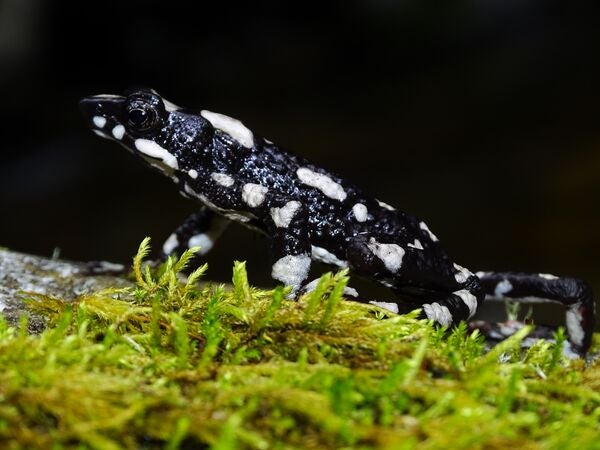
Scarlet Harlequin Toad

Scientific Name: Hynobius turkestanicus
Last Seen: 1909 in Turkmenistan
Years Lost: 115
Red List Status: Data Deficient

“Head compressed, longer than broad. Snout rounded, the length equaling interorbital width.”

These descriptions represent some of the only known details about the Turkestanian Salamander, which has been missing for more than a century. In fact, this species is only known from a few individuals collected at the beginning of the 20th century—since then, all specimens have been lost, as have all records of the salamander’s exact location.

If not extinct, the species may reside in the area between Pamir and Samarkand, in Kyrgyzstan, Tajikistan, or Uzbekistan. Similar to other known salamander species, the Turkestanian Salamander is presumed to breed in water and live on land as an adult.

Turkestanian Salamander

Scientific Name: Hynobius turkestanicus
Last Seen: 1909 in Turkmenistan
Red List Status: Data Deficient

“Head compressed, longer than broad. Snout rounded, the length equaling interorbital width.”

These descriptions represent some of the only known details about the Turkestanian Salamander, which has been missing for more than a century. In fact, this species is only known from a few individuals collected at the beginning of the 20th century—since then, all specimens have been lost, as have all records of the salamander’s exact location.

If not extinct, the species may reside in the area between Pamir and Samarkand, in Kyrgyzstan, Tajikistan, or Uzbekistan. Similar to other known salamander species, the Turkestanian Salamander is presumed to breed in water and live on land as an adult.

Stay in touch.

Get exclusive stories, behind-the-scenes updates, and ways to help—delivered to your inbox.

Donate for the wild.

Support real conservation impact—saving species, restoring ecosystems, and rewilding our world.

Donate